
Measure what will last.
A proprietary index for cultural, data, and economic staying power.
Most metrics measure attention. TVI measures what survives — without publishing the engine on this page.
Which datasets become infrastructure?
Teams pick on downloads, stars, and recency → brittle models, benchmark chasing, silent dataset decay.
TVI shows whether a dataset is becoming a default — or being quietly replaced.
- MNIST vs CIFAR vs ImageNet — lower downloads, higher temporal persistence.
- Why some datasets survive 20+ years.
Example output generated using the BoonMind TVI engine.
Stop betting your company on fads.
Holacracy, OKRs, SAFe, Spotify get adopted because others did — not because they last.
TVI-B shows which frameworks compound and which decay after consulting hype.
- Agile vs Holacracy
- Lean vs Growth Hacking
- SMART vs OKRs — time exposes the difference.
Example output generated using the BoonMind TVI engine.
Momentum lies. Time doesn’t.
Markets price growth, buzz, and stories — not durability, category control, or crisis survival.
ISPS shows which companies are becoming foundations, not just riding cycles.
- Apple vs Nokia
- Amazon vs Pets.com
- Crypto cycles.
Example output generated using the BoonMind TVI engine.
Virality is cheap. Cultural memory is rare.
Impressions, reach, and clicks ignore what becomes canon vs what disappears.
TVI shows which ideas become reference points — and which fade.
- A 1990 song vs a TikTok hit.
- A meme that lasted vs one that didn’t.
Example output generated using the BoonMind TVI engine.
Important: Calculator outputs are illustrative and designed for pattern recognition and long-horizon comparison. They are not licensed for commercial decision-making, investment advice, or operational use. For commercial applications, evaluation access, or licensed deployment, please contact us below.
Viral Content
TVI outputs are structural analytical estimates derived from configurable temporal weighting systems. Different domains, operating environments, and strategic objectives may produce different calibrated outputs using the same foundational framework.
What TVI Is
TVI (Temporal Validation Index) is an experimental systems-analysis framework for estimating whether something is likely to retain significance after hype, cycles, and platform churn have burned away.
TVI is a proprietary analytical framework developed by BoonMind.io. Patent Pending. The public calculator and demonstrations are provided for educational and evaluation purposes only. Commercial use, licensing, and API access require separate agreements.
Problem: Modern metrics are inflated by platform size, algorithms, hype cycles, and short-term engagement. They miss longevity, reuse, cross-domain adoption, and historical embedding.
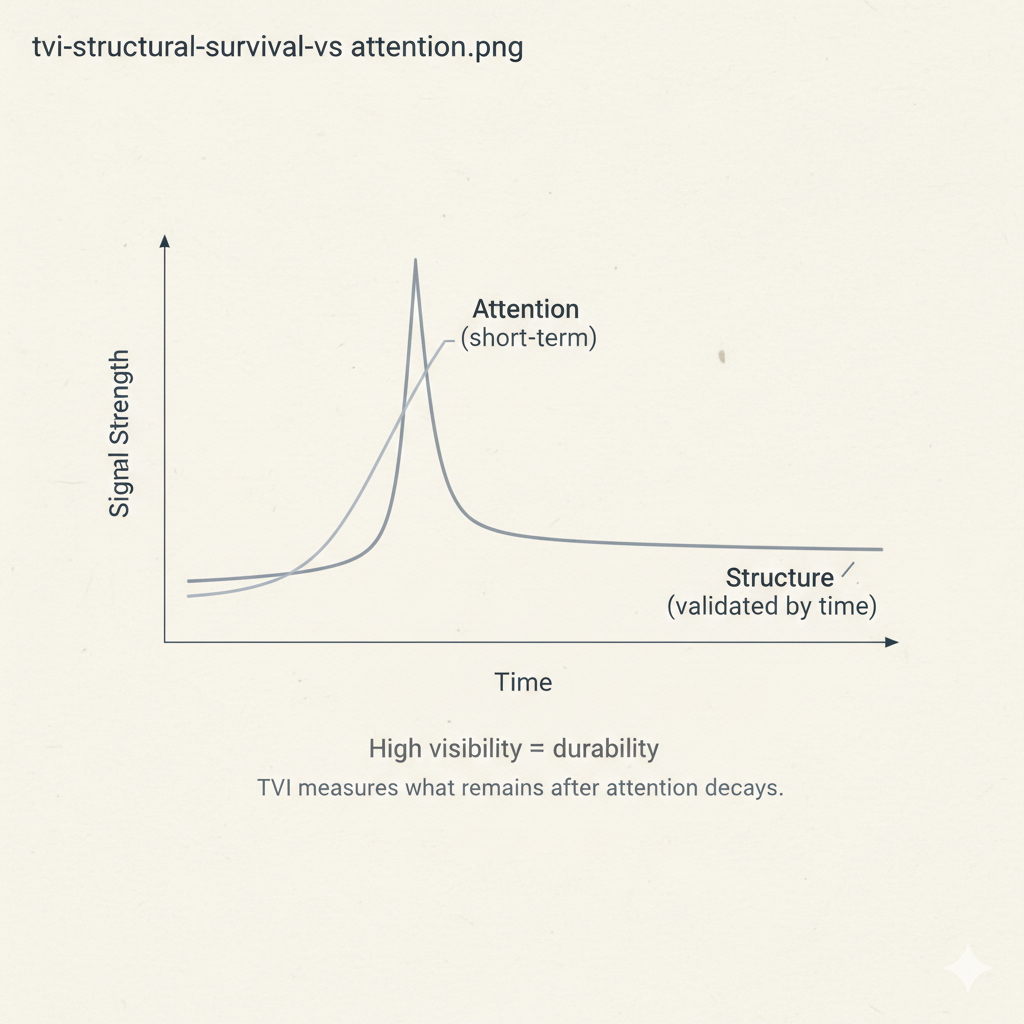
This chart contrasts short-term attention with long-term structural survival. Attention produces sharp but temporary spikes, while structurally validated signals persist after attention decays. TVI measures what remains once visibility fades.
TVI exists to answer one question: Is this real — or just temporarily loud?
What TVI measures (conceptual)
- Saturation: How fully something occupied the attention space of its era, relative to what was possible then.
- Temporal validation: Whether time has voted through persistence, resurfacing, and legacy signals.
- Structural resistance: How hard the environment made success — so easy eras do not over-credit loudness.
Proprietary engine. Full operators, coefficients, era tables, and component weightings are not published on this site and are not shipped to the browser. Beta users receive score, classification, and plain-language interpretation only.
Attention spikes; structure may persist. TVI is designed to measure the difference without exposing internal math.
This structure is intended to push hype without time toward collapse, scale without validation toward decay, and proven survival toward higher standing — details stay server-side.
Why This Matters
TVI is a risk-reduction engine for high-stakes decisions in brand impact, long-term value measurement, cultural measurement, media valuation, and effectiveness over time:
- AI & Data: Filter datasets/benchmarks by time-robustness, not popularity.
- Governance & Policy: Separate real standards from policy theater.
- Business & Strategy: See which methods became infrastructure vs fads.
- Finance & Investment: Identify foundations, not trades — survival, crisis-resistance, dominance persistence.
- Brand & Marketing Analytics: Measure long-term cultural impact and media valuation beyond short-term engagement metrics.
Output: One interpretive model for asking whether long-horizon durability signals support the case for persistence.
The calculator represents a public-facing abstraction layer of the broader TVI framework currently undergoing active calibration and beta evaluation.
Form fields on this page (C, persistence, resurfacing, legacy) are a teaching layer so you can feel the three terms. Production coefficients and era tables stay on the server and are not these fields.
Exploratory note — WeWork
Illustrative retrospective only. The framework may have flagged structural fragility inconsistent with the prevailing narrative in that period. This is not a sealed backtest, not demonstrated predictive performance, and not investment advice. Residual tests and limits: /evidence.
Commercial Use & Licensing
TVI operates across three access layers:
1. Public / Demonstrative
The calculator and sample outputs on this site are provided for educational and evaluation purposes. They demonstrate TVI's approach to temporal validation, pattern recognition, and long-horizon comparison. These outputs do not grant commercial usage rights.
2. Evaluation / Registered Access
For organizations evaluating TVI for internal use, brand impact measurement, media valuation, or cultural analytics, registered evaluation access provides expanded capabilities and documentation. This includes deeper pattern analysis, historical comparisons, and framework documentation.
3. Commercial / Licensed Use
Commercial licensing is required for: operational decision-making, investment analysis, client deliverables, API integration, white-label deployment, or any use where TVI scores inform business outcomes. Licensed access is contracted scope — not a published formula dump.
Bespoke Temporal Intelligence Dashboards
TVI dashboards are modular, configurable, and domain-adaptive. Different operational environments require different persistence models, resilience assumptions, validation horizons, and reporting structures.
Enterprise deployments may include custom weighting architectures, sector-specific calibration, resilience scoring layers, adaptive validation thresholds, institutional durability metrics, proprietary benchmark systems, persistence sensitivity modelling, comparative risk mapping, and bespoke reporting environments.
Dashboards may be configured for investment analysis, institutional resilience, organisational durability, AI dataset evaluation, strategic fragility assessment, and long-horizon system analysis. All modelling assumptions remain transparent and inspectable within the analytical environment.
Public vs Proprietary Modelling Layers
Public layer: This site describes the idea (what, why, conceptual how). The production engine, coefficients, and thresholds remain proprietary trade secrets.
Proprietary layer: coefficients, era tables, and operators stay on the server. Licensed deployments are contracted scope — discussed by email, not a published SKU list on this page.
When Is a License Required?
A TVI license is required when:
- TVI scores inform investment decisions, capital allocation, or portfolio management
- TVI analysis is included in client reports, deliverables, or advisory services
- TVI is integrated into internal analytics, dashboards, or decision-support systems
- TVI methodology is used for brand impact measurement, media valuation, or marketing analytics
- API access is needed for programmatic TVI calculation or bulk analysis
- White-label deployment is required for partner or client-facing applications
Who Is TVI For?
TVI is designed for:
- Investment firms and asset managers seeking downside protection and structural validation
- Brand and marketing analytics teams measuring long-term cultural impact and media effectiveness
- Media companies and content platforms evaluating long-term value and cultural measurement
- AI and data organizations assessing dataset durability and benchmark staying power
- Business strategy teams distinguishing infrastructure from fads in methodology adoption
- Research institutions and consultancies requiring validated temporal frameworks
Next Steps
Contact → Discuss your use case and evaluation needs
Evaluation → Access expanded capabilities and documentation
Licensing → Secure commercial usage rights and API access
Deployment → Integrate TVI into your analytics, advisory, or operational workflows
Evaluation materials available on request.
Framework Concepts
Deep visualizations of the TVI framework's core principles and applications.
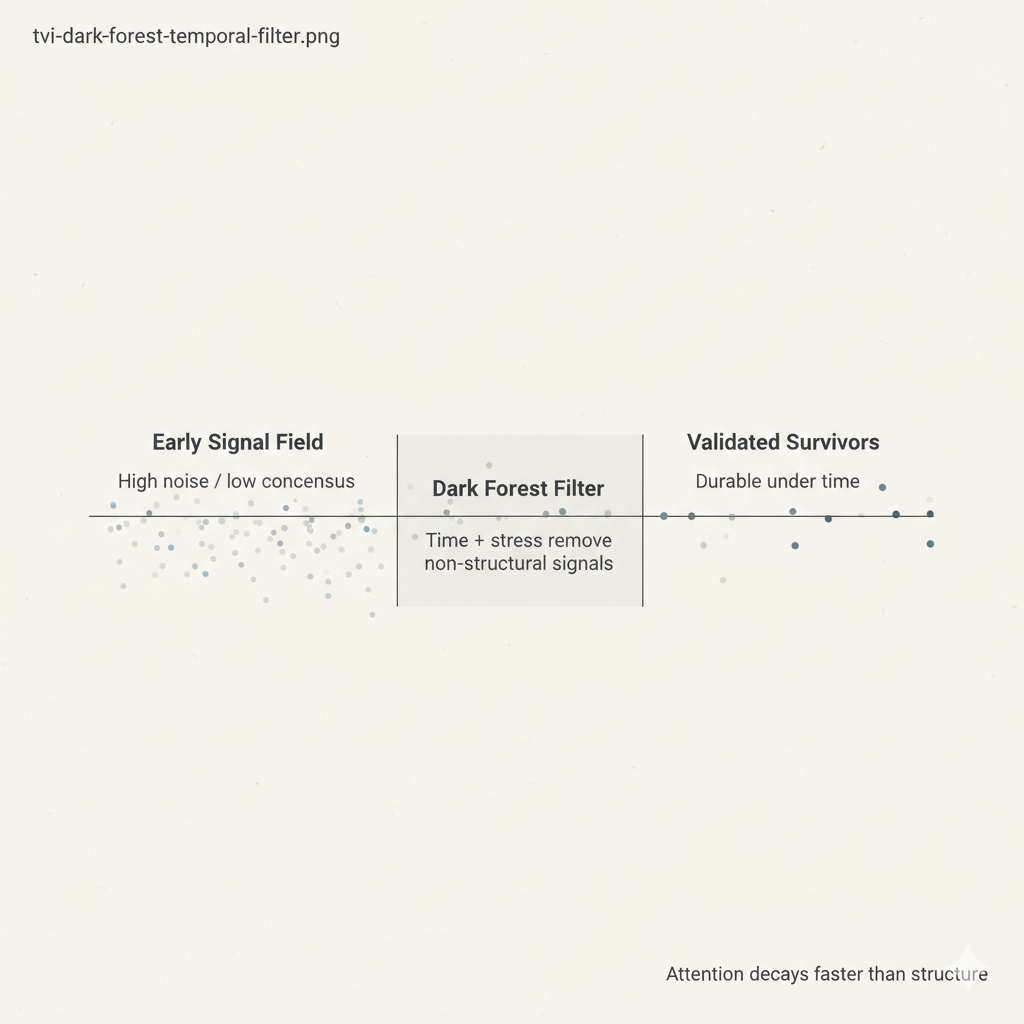
The Dark Forest Filter
Early signals enter a "dark forest" of temporal validation. Time and stress remove weak, non-structural signals. Only those with genuine durability survive the filter.
This diagram illustrates how early high-noise, low-consensus signals are filtered over time. The "Dark Forest Filter" represents temporal validation, where stress and duration eliminate non-structural signals, leaving only those that remain durable under real-world conditions.
Structural Viability After Stress
When a shock event occurs, systems with low structural resistance enter irreversible decline. High-resistance systems decline slowly and retain recovery potential. Time acts as a stress multiplier—the longer you survive under pressure, the more durable you prove to be.
Decay dynamics: Structural resistance determines whether you recover from crisis or collapse into it.
The Breakthrough (Crisis-Proof Infrastructure)
High structural validation means the thing is behaving more like infrastructure than like a guest in the market. That is a comparative claim, not invulnerability.
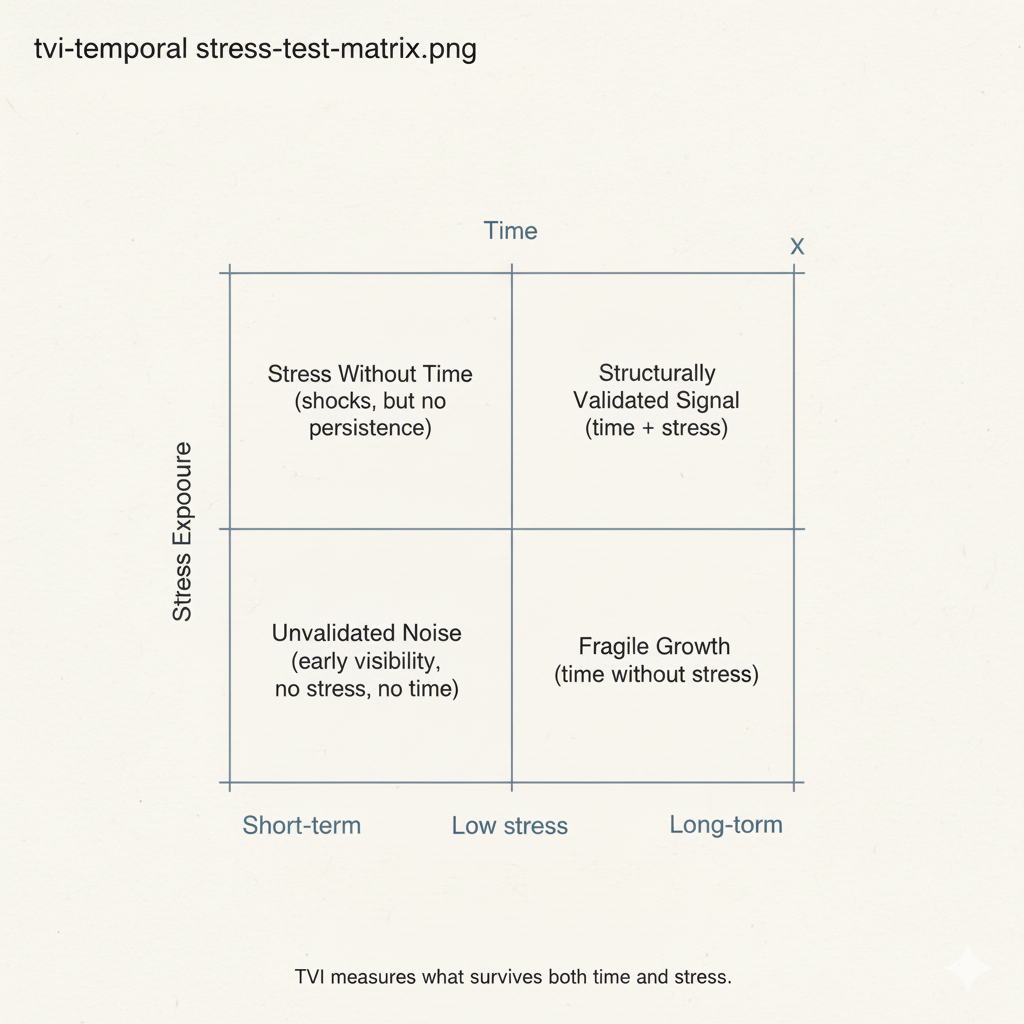
This matrix visualizes how signals behave under combinations of time and stress. Only signals exposed to both long-term duration and real stress achieve structural validation. TVI measures survival across both dimensions.
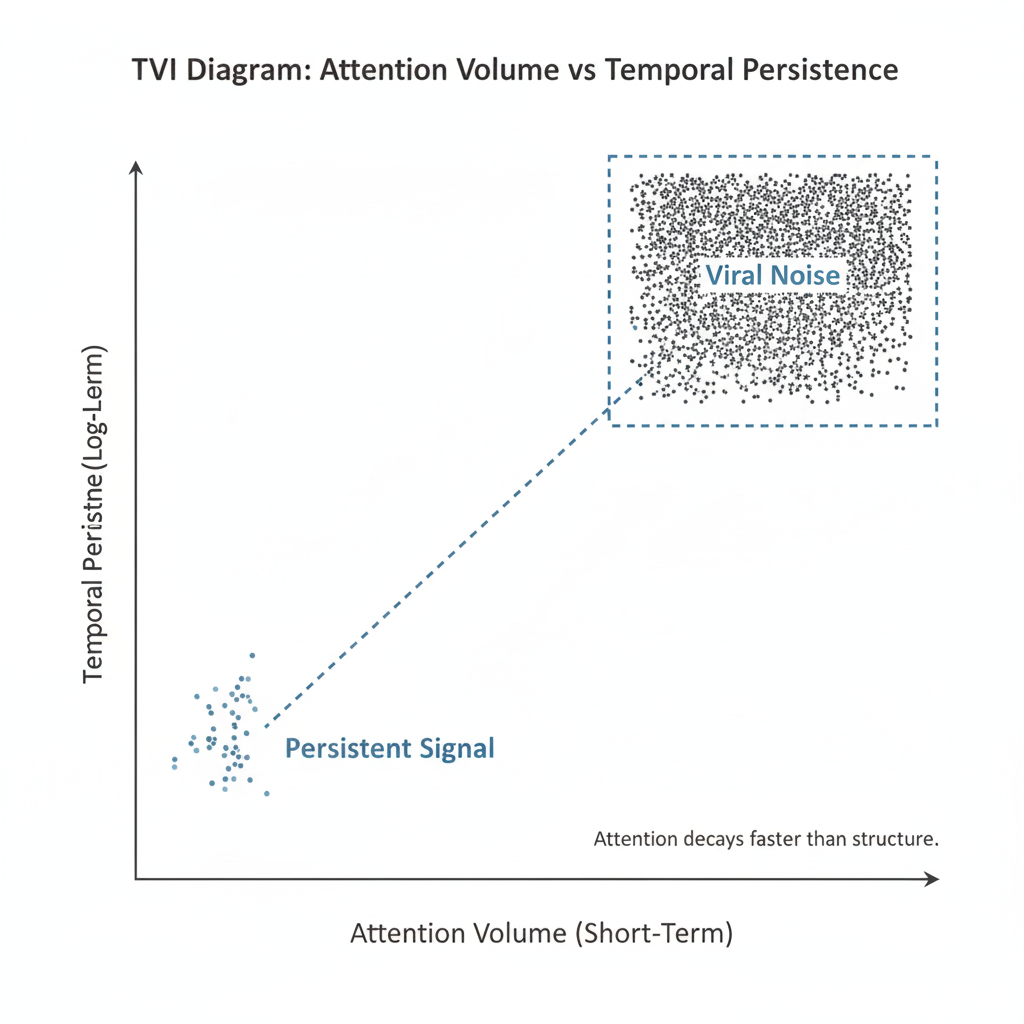
Attention vs. Temporal Persistence
Most signals cluster in high-attention, low-persistence space—viral noise that burns bright and vanishes. A small subset achieves the opposite: lower initial attention, but high long-term persistence. TVI measures what remains after visibility fades.
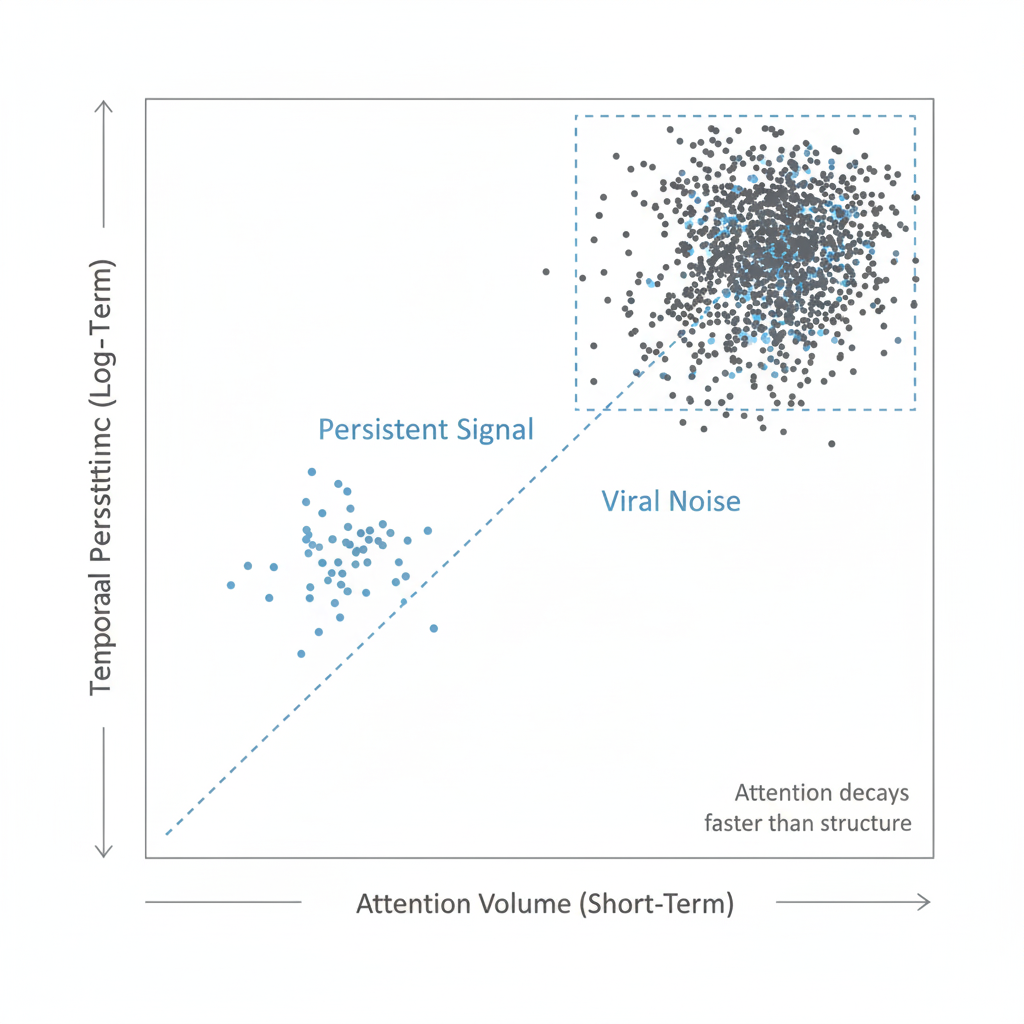
The dissonance: Virality is a 24-hour phenomenon. Cultural legacy is built on density, not volume.
Quick Compare
Select two items and see which has more staying power.


